
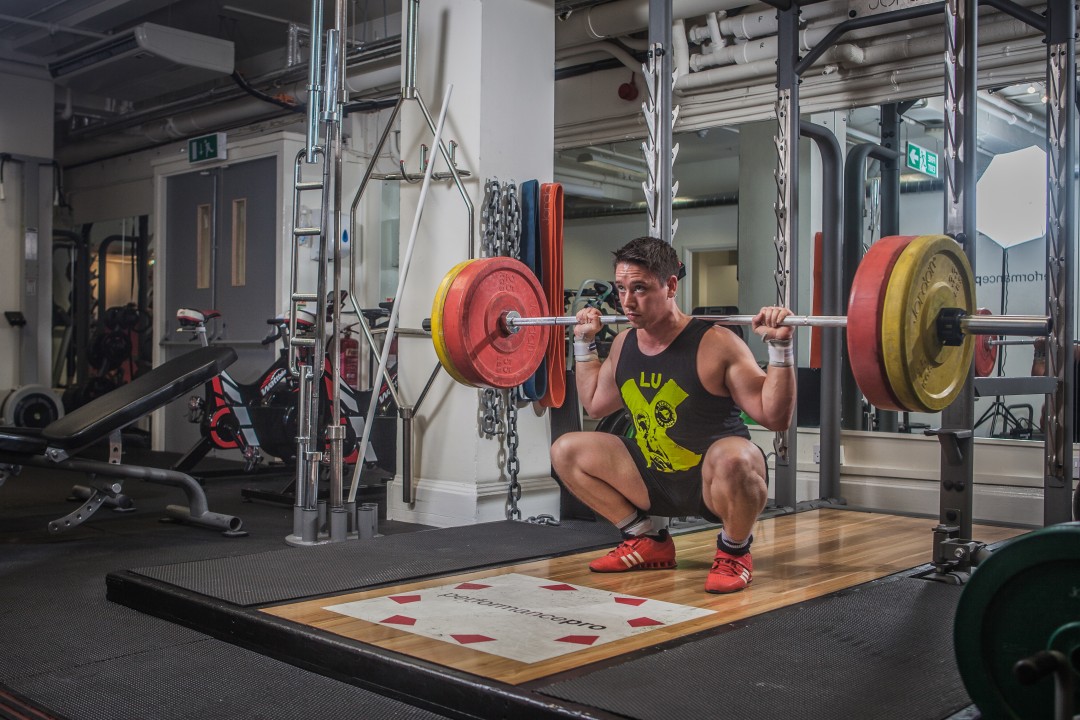
Heralded by many as the king of exercises and the backbone of many strength training programmes the back squat is arguably one of the hardest to get right. If you take a lesson from any Olympic lifter you’ll note the true full body nature of the squat – something that is missing from the average gym users attempt to get ‘ass to grass’. Top strength coaches disagree on the necessity to back squat over front squatting and whether the bilateral squat (both legs) provides superior results to unilateral squat movements (single leg). Research has shown both can produce improvements in strength, power and reduce risk of injury.
So what is the squat? Firstly let me make it clear that I am talking about the full squat, where depth is reached only once the hamstrings are in contact with the calf muscles i.e. the femur has moved past parallel to the floor whilst maintaining a strong torso as upright as possible, the chest should not touch the thighs. Disagreements arise when we take into account the multitude of squat variations. They all differ in some small way; the sumo squat uses a wider stance and depth will be limited in most cases to parallel (often seen in powerlifting), the front and back squat use largely the same musculature but the change in centre of mass means a bigger torso lean in the back squat in order to stay over the base of support. The low bar squat goes one step further and moves the centre of mass down the back, changing lever length and creating an even greater torso angle. All are different, none are wrong, and yet all can be performed correctly or incorrectly. So why do people get it wrong so often? How can they improve?
A combination of mobility and balance are required to perform the full squat. As such the overhead squat – where a bar is held in a wide grip fully extended over the crown of the head – is a widely accepted tool for assessing a persons readiness to train. Mobility of the ankles, knees, hips, lumbar and thoracic regions of the spine, shoulder and scapular all show up in the test. Even when a person has the required mobility in all regions, they still have to be able to coordinate the correct movement pattern and maintain balance. This is where as a function of strength, the ability to recruit the right muscles in the right order to the required extent comes into play.
As a general rule, we believe full squatting properly can be taught only once the required level of mobility and strength are achieved. Unilateral exercises where the base of support is larger, such as the split squat, are a great starting point and full range can often be far easier to accomplish. My goal is to get people who need to squat to that point as quickly as possible, but everyone is different and there are so many variations on the squat that sticking dogmatically to one type is doing yourself or your client a disservice.
 Our passionate, knowledgeable and friendly team will use innovative and sometimes surprising techniques to get you there faster. Combining the best in personal training and rehab in one clinic, our team of ex-athletes and strength & conditioning trainers give you advice and use equipment that’s the preserve of elite athletes.