
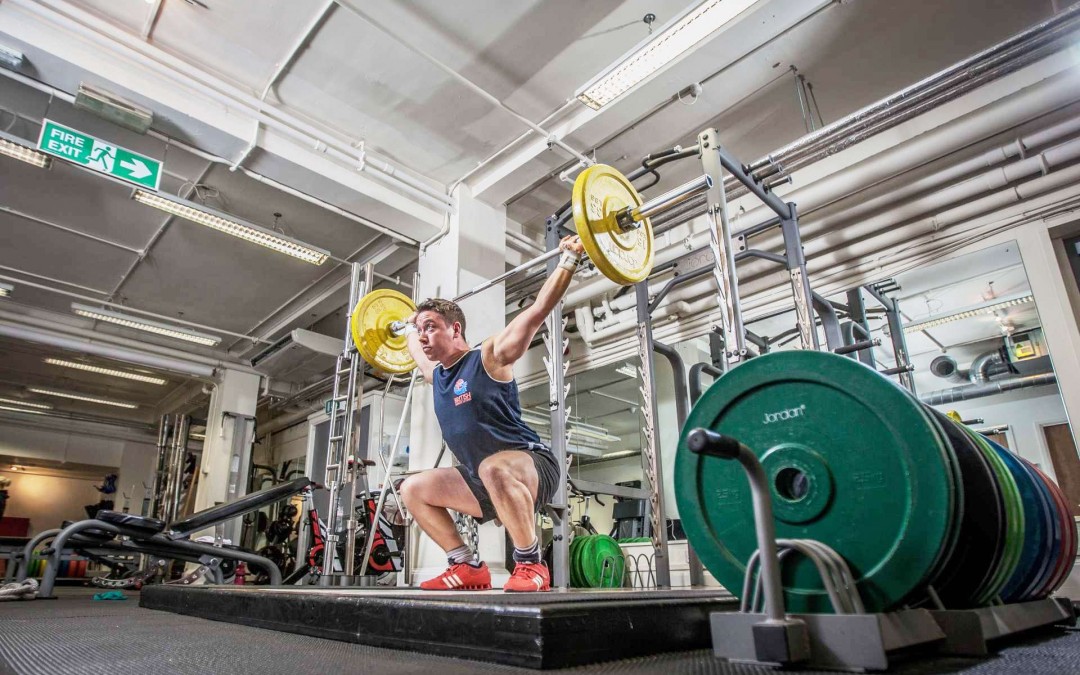
For those of you who aren’t aware of the sport of weightlifting, it is a full time and professional sport worldwide. Athletes in some countries receive better funding and training – predominantly in the East and Far East. Careers culminate in competing for medals at the Olympics and yearly World Championships but also involve regular national and regional competitions. The UK is growing in participation and in doing so even has it’s own Lifting League (click here for participating clubs and more information).
Although here in London there are a number of internationally experienced coaches (see BWL), the great past and present success of the Eastern methodologies prove to be more and more popular here. I had the chance to meet and train with Apti Aukhadov – the 85kg Russian and 2013 World champion and 2012 Olympic silver medalist.
The company that provides the weights and bars for the biggest competitions is Swedish manufacturer Eleiko. Having seen first hand their factory in Halmstad, I know that every bar and competition disc is tested rigorously and is in my opinion the best money can buy. Apti is their poster boy. Apart from being fantastically strong he is considered one of the best technical lifters among current athletes. Oh, and he’s 22 years old.
Here are my four biggest lessons from Apti. If you lift already this should resonate, and if not, I hope it will make you consider trying weightlifting and becoming stronger, faster and more powerful than ever before.
Lesson 1: Training must be practice. As I don’t speak Russian and Apti’s English is a little limited, I’m not sure if there was a direct translation but the point remains. He approaches each training session with the intention of getting better. Not just fitter, stronger, faster and leaner like many of us in the gym. His training is focused on being better in every lift, every repetition and every aspect of the movements.
Lesson 2: Less is more, but only if less is better. By which I mean, Apti only trained for around 45/50 minutes on the day we saw him. Sometimes he trains for 2 hours, but that day the scheduled session was short, low in volume of lifts, and light (for him – it’s all relative when you can clean and jerk 215kg). He came away knowing he could do more. His coach (also his father) knows that this sessions purpose was not to do as much as possible, but to do as much perfectly as possible. That required not going to failure and not being so tired that technique was compromised. Those days will come too.
Lesson 3: As a coach, say less. My first thought as someone being taught by a non English speaking coach is “I won’t know what he wants me to do”. As the coach you might question how the athlete will understand you. In reality, however, it was brilliant. He used around 5 words and can clearly demonstrate physically. That was all it took to coach a room of 20+ lifters and yet everyone of us learnt from and enjoyed the experience. I’d dare say each one of us also got better. Be concise, be clear and every so often say “well done” in a Russian accent – you’ll be a better coach.
Lesson 4: Your technique should not be different at 40% and 95% of your best lift. This, Apti stressed very clearly. Maybe at 100% you’ll be straining and things will change/get a little unorthodox but at lower percentages of your maximum you should be lifting consistently. Technical proficiency therefore comes as top priority unless you want to get injured or worse – not lift heavy!
Being efficient is different to just being strong, and this is why Apti -who is insanely good – competes against people who may be stronger.
 Our passionate, knowledgeable and friendly team will use innovative and sometimes surprising techniques to get you there faster. Combining the best in personal training and rehab in one clinic, our team of ex-athletes and strength & conditioning trainers give you advice and use equipment that’s the preserve of elite athletes.